
![What Is the History of Coffee? [Global Journey]](https://caffeinecue.com/wp-content/uploads/2026/06/What-Is-the-History-of-Coffee-Global-Journey-1024x512.jpg)
The History of Coffee: A Global Journey in Every Cup
Coffee has a rich and fascinating history that started in Ethiopia and slowly reached every part of the world. From ancient coffee beans discovered in Africa to busy coffeehouses in Arabia, Europe, and beyond, coffee became more than just a drink. It became a part of culture, trade, daily life, and social connection.
The journey of coffee shows how one simple beverage turned into a global habit loved by millions. Over time, different countries created their own brewing methods, coffee traditions, and unique ways to enjoy it. Today, every mug of coffee carries a story of history, flavor, travel, and human connection.
The Early Origin of Coffee
Coffee began its story in the green highlands of Ethiopia, a region often known as the birthplace of coffee. This area is linked to one of the most famous stories in the history of coffee, which explains how people may have first noticed the power of the coffee plant.
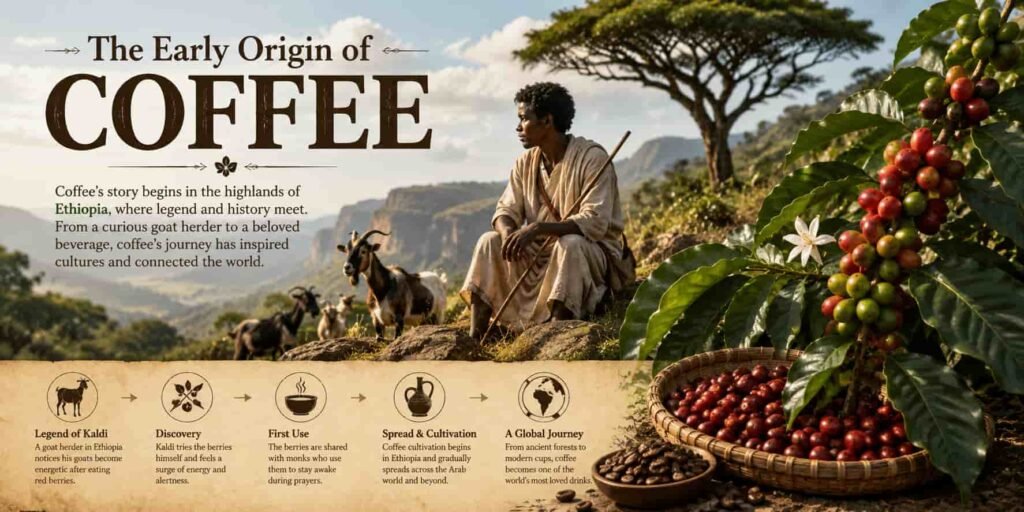
According to legend, a young goat herder named Kaldi saw that his goats became unusually active after eating bright red coffee cherries from a wild bush. He became curious and tasted the coffee berries himself. Soon, he also felt more awake and full of energy.
Although this story may be more legend than proven fact, it clearly shows how coffee discovery may have started by chance. In the beginning, people did not drink coffee as we do today. Local communities first ate the coffee fruit for its natural stimulating effect. Over time, people learned new ways of preparing it, which later led to the brewed coffee we now enjoy.
From these simple beginnings in Ethiopia, coffee slowly became a respected beverage, a part of coffee culture, and an important product in the global coffee journey.
Read Also:Espresso vs Coffee: More Caffeine? [Real Facts]Coffee’s Global Journey
Coffee gradually spread across the world through ancient trade routes. Its journey reached the Arabian Peninsula, where Yemen became one of the most important centers of early coffee culture. The drink also became closely linked with Mocha, a famous Yemeni port city known for its role in the coffee trade.
Over time, coffee houses became popular social places. People gathered there to drink freshly brewed coffee, share ideas, discuss news, and build community connections. The rich smell of roasted coffee beans made these places warm and welcoming.
From Yemen, coffee continued its journey to Persia, Egypt, Syria, and Turkey. This movement shows how culture, trade, innovation, social life, and tradition helped coffee become a global drink.
Today, every cup of coffee carries a part of this long historical journey. It connects people with different societies, traditions, regions, and cultures across the world.
Coffee Houses as Centers of Social Life
Coffee houses became important social spaces in the Arabian Peninsula and many nearby regions. In busy towns and cities, people visited these places to drink coffee, meet others, and take part in daily community life.

From Constantinople to Cairo, early coffee houses were full of conversation, music, games, and cultural activity. People from different backgrounds gathered there to share news, discuss ideas, build friendships, and learn from one another. Because of this, these places became known as “Schools of the Wise.”
These early coffee shops helped shape the modern cafe culture we see today. They showed that coffee was more than a drink; it became a symbol of social connection, cultural exchange, learning, discussion, hospitality, tradition, and public life.
Important Moments in Coffee History
The history of coffee includes many important events that helped this drink become popular across the world. From its legendary beginning in Ethiopia to its growth through Arabian trade routes, coffee culture slowly became part of daily life in many countries.
| Year | Key Event | Location |
|---|---|---|
| 800s | Coffee was traditionally linked to the story of Ethiopian goats discovering coffee berries. | Ethiopia |
| 1100s | Coffee cultivation and early coffee trade began to grow in Arabia. | Arabian Peninsula |
| 1400s | Early coffeehouses became popular places for discussion and social life. | Mecca |
| 1600s | Coffee reached Europe through trade, especially through Venice. | Venice, Italy |
| 1652 | The first known coffeehouse opened in London. | London, England |
| 1714 | King Louis XIV received a coffee plant for the Paris Botanical Garden. | Paris, France |
| 1723 | Coffee planting expanded in the Caribbean and later supported growth in Latin America. | Martinique, Caribbean |
| 1773 | After the Boston Tea Party, coffee became a popular patriotic drink in America. | Boston, USA |
| Early 1900s | Instant coffee was developed, making coffee easier and faster to prepare. | United States |
These coffee milestones show how coffee moved from a local discovery to a global drink. Its journey reflects trade, culture, agriculture, innovation, social connection, economic growth, coffeehouses, cafe culture, global influence, and historical development. Today, coffee remains one of the most recognized drinks in the world.
Coffee’s Journey into European Culture
Coffee entered Europe through active trade routes, especially through Venetian traders. Its rich aroma, unique taste, and cultural value quickly attracted people across European markets. What began as an exotic beverage soon became a popular part of daily life.
In Venice, the first European coffeehouses helped introduce a new style of public gathering. Coffee was enjoyed by wealthy people as well as ordinary citizens, making it both a symbol of leisure, comfort, sophistication, and social connection.
As coffee spread to major cities such as London and Paris, coffee shops became important centers of social life. People gathered there to drink coffee, exchange ideas, read news, discuss business, and take part in lively debates.
These early cafes were more than places for relaxation. They supported intellectual exchange, political discussion, cultural interaction, public debate, friendship, community building, and European coffee culture. Coffee helped bring people from different backgrounds together in one shared space.
Today, every cup of coffee carries this long historical journey. It reminds us how coffee shaped European society, encouraged conversation, and created lasting traditions of connection and hospitality.
Coffee’s Growth in the Americas
Coffee became part of American culture when European settlers brought coffee plants to the New World. The climate in many parts of the Americas supported coffee cultivation, allowing the drink to grow in both popularity and production.

In the United States, coffee houses became important places for daily life, business meetings, social interaction, public discussion, and community building. Cities such as New York helped shape early American coffee culture, where people gathered to share ideas and connect with others.
Coffee became even more important after the Boston Tea Party in 1773. Many colonists moved away from tea because it was linked with British taxation. As a result, coffee became a strong symbol of American identity, independence, patriotism, and political choice.
Today, Latin America plays a major role in the global coffee industry. Countries such as Brazil are known for producing high-quality coffee beans and supplying coffee to markets around the world. This shows how coffee became deeply connected with agriculture, trade, economy, culture, history, and everyday life across the Americas.
Read Also: 9 Interesting Facts About Coffee [Dark Secrets & Myths]Coffee as a Modern Global Tradition
Coffee has become a powerful part of modern society and daily life. Its journey from Ethiopia to the rest of the world shows how one simple bean became connected with culture, tradition, productivity, creativity, and social connection.
Today, people enjoy coffee in many different ways, from a morning espresso in Italy to busy coffee shops in Seattle and other major cities. Coffee brings people together, supports conversations, and often helps people feel focused and energized during work, study, and creative tasks.
Coffee also crosses languages, countries, cultures, and social boundaries. It reminds us that people around the world share similar habits, emotions, and daily routines. Every cup reflects a long process that includes farmers, cultivation, harvesting, roasting, brewing, trade, hospitality, and global connection.
In contemporary life, coffee is more than a drink. It is a symbol of history, community, cultural identity, shared experience, economic value, and human connection.
Final Thought
Coffee’s journey from Ethiopia to the wider world shows how one simple bean became part of global culture.Through trade routes, coffeehouses, cultivation, and brewing traditions, coffee connected people across different countries and societies.It shaped social life, business discussions, cultural exchange, and daily routines in many parts of the world.From Arabia and Europe to the Americas, coffee became more than a drink; it became a symbol of community, creativity, and human connection.Today, every cup of coffee carries a rich story of history, flavor, travel, agriculture, and tradition.This makes coffee one of the most meaningful and loved beverages in the modern world.
FAQ’s: What Is the History of Coffee? [Global Journey]
What role did coffee play in modern history?
In the modern history of coffee, global trade became more organized when the International Coffee Organization was created to support coffee trade and coffee-producing economies. During the same period, Robusta coffee spread across Vietnam, West Africa, and Southeast Asia because it was stronger, easier to grow, and had higher caffeine than Arabica coffee.
When did coffee become part of social culture?
Coffee culture began to grow in the 15th century when coffeehouses, known as qahveh khaneh, appeared in Mecca. These places became important centers for social gatherings, conversation, news, and community life. Later, in the 16th century, this coffeehouse culture spread to Constantinople, now called Istanbul.
How did coffee become popular during the 20th century?
Coffee became more popular in the 20th century because instant coffee made it quick and easy to prepare, while espresso machines improved its taste and style. These changes helped the coffee industry grow worldwide. Although coffee folklore mentions Kaldi, its deeper coffee history is linked to the Oromo people of Ethiopia.
Who discovered coffee?
The exact discovery of coffee is not fully proven, but a popular legend says that Kaldi, an Arab goatherd, first noticed it. He saw his goats acting energetic after eating coffee berries, which led people to explore the stimulating effects of coffee beans.
Is coffee enjoyed around the world?
Yes, coffee is a truly global beverage. It is commercially grown across several continents and widely consumed in almost every part of the world. From daily coffee culture on Earth to an espresso machine used on the International Space Station, coffee has become a worldwide drink.